Experiment Design
Experiments work best when the question is narrow, the product surface is clear, and the expected effect is large enough to detect with the traffic available. Treat the design as an operating plan: define the decision, choose a primary signal, protect key guardrails, and keep monitoring after launch.
Product matrix
Use the matrix to connect each product surface to a decision and a measurable signal before implementation starts.
| Product surface | Decision to support | Primary signal | Guardrail |
|---|---|---|---|
| Landing page | Is the offer clear enough to continue? | Primary action click-through | Bounce rate and page speed |
| Product information | Can visitors find the right support path? | Privacy or open-link engagement | Contact load and broken-link rate |
| Scientific notes | Do study pages support exploration? | Note opens and model interaction | Time to interaction and math-render health |
| Analytics view | Are measurements trustworthy enough to act on? | Visitor and route-count freshness | Missing events and database write errors |
Sample strategy
- Define the unit of assignment before launch: visitor, account, session, or device.
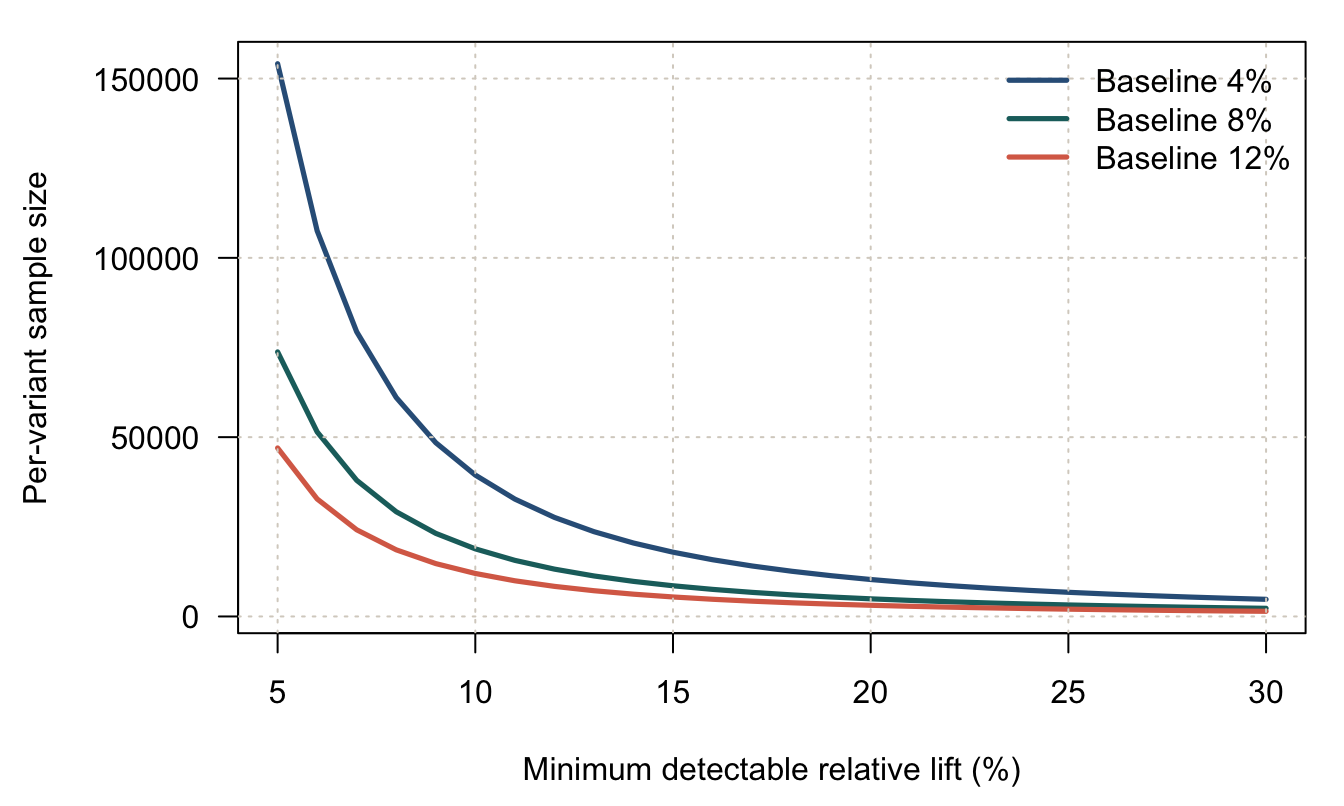
- Estimate baseline rate and minimum detectable lift before choosing the experiment window.
- Keep the primary segment broad; reserve narrow slices for diagnosis after the main readout.
- Use guardrails for performance, accessibility, form errors, and privacy-sensitive flows.
- Stop only after the preplanned sample window unless a safety guardrail fails.
Sample size calculator
Use the product matrix as the target matrix for the experiment: choose the product surface, decision, primary signal, and guardrail before estimating sample needs. Baseline rate is the current percentage of eligible visitors, accounts, or sessions that complete the chosen primary signal in the control experience.
For a two-arm conversion experiment, use the same planning approximation as the site API. Let \(p_1\) be the baseline rate, \(p_2\) the variant rate after the minimum detectable lift, \(\bar{p} = (p_1 + p_2) / 2\), and \(\Delta = |p_2 - p_1|\). The per-variant sample size is approximated by
\[ n = \frac{ \left( 1.96\sqrt{2\bar{p}(1-\bar{p})} + z_\beta\sqrt{p_1(1-p_1) + p_2(1-p_2)} \right)^2 }{ \Delta^2 }. \]
For early planning, the figures below use 80% power, two-sided 5% significance, and relative lift as the minimum detectable effect.
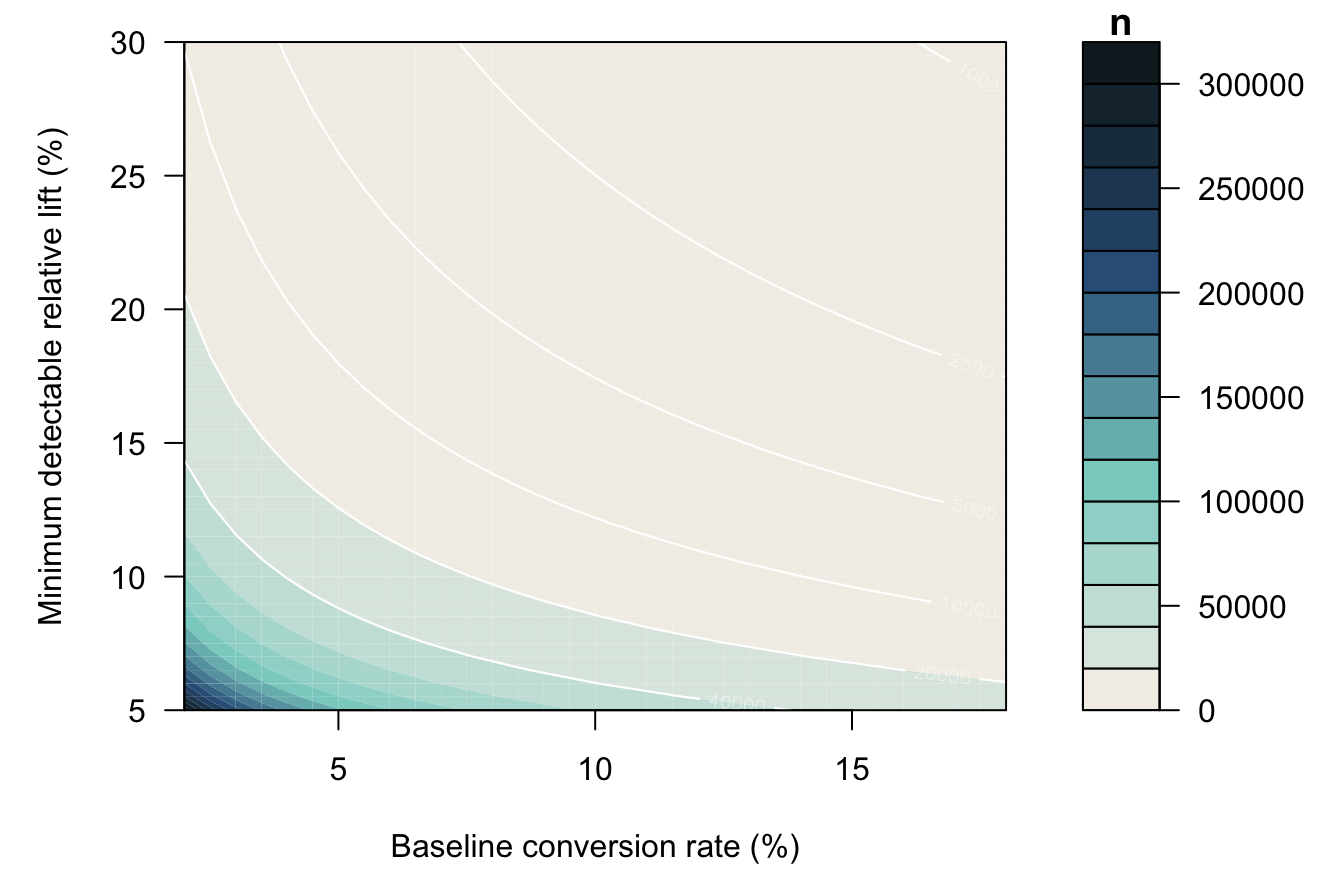
Use these figures as feasibility checks before treating a planned experiment as measurable. If the required sample is much larger than available traffic, broaden the product surface, increase the decision window, or choose a larger effect that would be worth acting on.
Continuous quality monitoring
- Confirm that event names, route names, and timestamps remain stable across deploys.
- Watch daily traffic, conversion, error rate, and response time for sudden shifts.
- Compare new results against historical baselines before treating a lift as product truth.
- Review accessibility and performance checks with every visible page change.
- Keep a short decision log: hypothesis, sample window, result, action, and follow-up owner.